Client Requirements
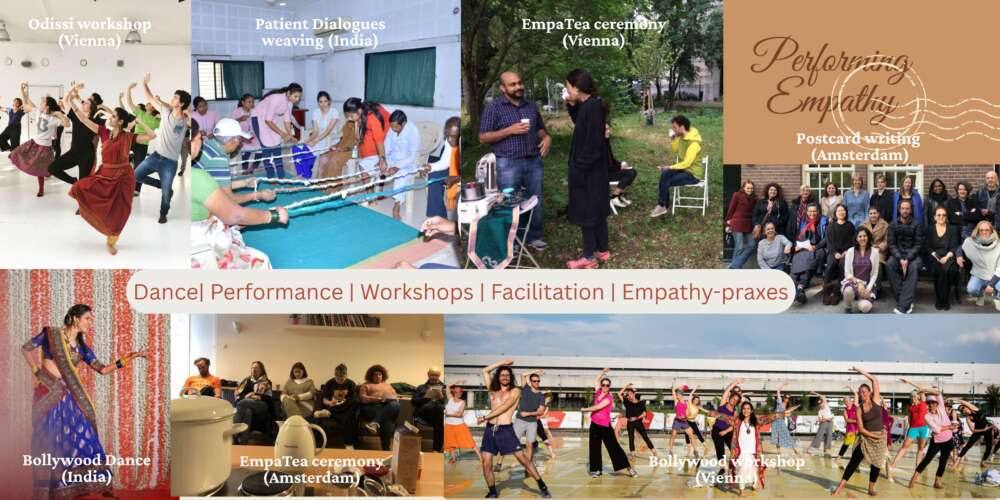
Microphone. Requirements will vary accrotding to offered session. E.g. Dance: music system, dance mat/ clean floor. Empathy-practices: writing material, chairs, table, chai ingredients, wool/threads.
Additional Notes
I enjoy performing but also facilitating and choreographing/ enabling others to perform to the best of their potential by addressing their inner, hidden strengths and weaknesses, using innovative artistic methods. I bring a strong technique in dance, drama, teaching, and facilitation and as an artist – dancer, performer, actor I have performed extensively in India and Europe. Thus, I consider myself a cultural ambassador.
With a commitment to social impact, I interlace my academic and performance expertise to create exciting spaces for social interaction infused with empathy. Rooted in academic philosophy and Social Sculpture ideas, I view art as transformative and essential to social connection. My research on performer-audience empathy also includes diverse ages and abilities.
Working values and principles:
Difference as a value: We usually connect with people with whom we have shared interests and similarities of age, background, etc. However, in my work, we will focus on differences as the connecting membrane to form rhizomatic relations – which can grow in any direction, from anywhere, always experimenting in a new direction. Rather than make differences the villain or othering factor, let’s treat it as a value.
Warmth work: Joseph Beuys’ social sculpture works on the warmth principle i.e. of warming up our thoughts, making them malleable to allow shifts in our hard-set attitudes, habits and values like biases, prejudices, stigma. For this, we use warmth materials like ginger, turmeric, charcoal, henna, rangoli.
An-aesthetic: Shelley Sacks proposes understanding aesthetic as the opposite of an-aesthetic; thus aesthetic as something that enlivens our being. Following her, I treat social interaction as an aesthetic process, forming connection using imagination, reflection, active listening and dialogue (David Bohm’s sense).
Response-ability: Also borrowed from Shelley Sacks, we will engage our response-ability which stems from within, rather than a responsibility which is thrust upon us from without (by god, state, parents, etc.).