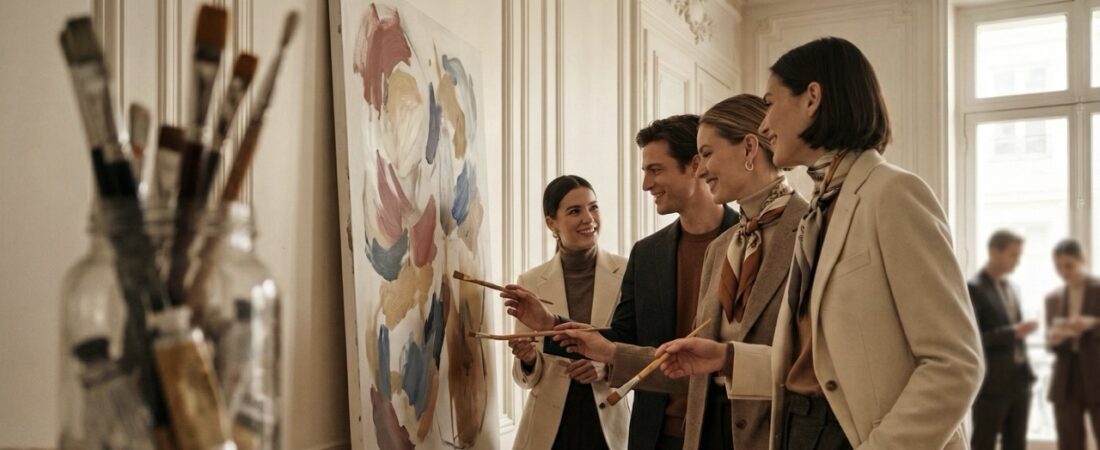
In the art world, the “Vernissage” (or varnishing day) is a ritual of completion. It is the moment a private creation becomes a public reality. It is a celebration not just of the canvas, but of the labor that produced it.
In the corporate world, we rarely have Vernissages. We have “post-mortems.”
When a project concludes, we analyze the metrics, archive the files, and disband the sprint team. We treat the output as a transaction. As a result, teams often lack a tangible sense of shared legacy. They work side-by-side, but they rarely feel like they are building a cathedral together; they feel like they are laying bricks in parallel.
To bridge the gap between “working together” and “creating together,” forward-thinking leaders are turning to the atelier. They are discovering that the messiest, most analog form of collaboration—making art—is actually the most efficient way to model high-performance dynamics.
The Problem with Competitive Team Building
The standard menu of corporate offsite activities—go-karting, trivia nights, escape rooms—suffers from a structural flaw: they are competitive. They divide the group into “winners” and “losers.”
While competition can spike adrenaline, it does not build the “connective tissue” required for complex problem-solving. It reinforces silos.
Co-creation operates on a different neurological frequency. When a team stands before a single, massive canvas, the dynamic shifts from Me vs. You to Us vs. The Abstract. The challenge is shared. The hierarchy dissolves. The General Counsel must pass the brush to the Junior Analyst.
The Data on Collaborative Performance
This shift from competition to co-creation is not just a “feel-good” exercise; it is a performance multiplier.
Research from the MIT Sloan School of Management highlights the profound impact of knowledge-sharing structures—the core mechanic of co-creation—on team output. The data suggests that teams structured to share ownership of a problem significantly outperform those structured to hoard it.
Vitality Insight Teams that engage in knowledge-sharing and co-creation structures drive 40% higher collaborative performance compared to those operating in silos. Source: Encyclopedia of Vitality (MIT Sloan Management Review)
When you force a team to co-create a physical object, you are essentially running a simulation of this high-performance behavior. You are training the “muscle” of 40% higher output.
The Human Moment: A Living Artifact
We recently worked with the Executive Committee of a pharmaceutical giant in Switzerland. They were a group of brilliant individuals who operated like an archipelago—distinct islands of expertise with no bridges.
We curated our Signature Living Artwork Experience. Over the course of a half-day session, they did not build a strategy deck; they built a physical installation.
They had to integrate personal artifacts and company symbols into a large-scale mixed-media piece. The process required negotiation (“Where does this piece fit?”), vulnerability (“This artifact represents my first failure”), and physical coordination.
The result was a stunning, textured artwork that now hangs in their headquarters atrium. But the real result was the shift in their dynamic. Every time they walk past that artwork, they experience a “memory anchor” of their alignment. It is a permanent reminder that they are capable of building a coherent whole from disparate parts.
The Protocol: Designing the Vernissage
How do you bring the “Vernissage Effect” into a standard office?
- One Canvas, Many Hands: Never ask a team to create individual pieces of art. The magic lies in the friction of the shared surface. They must negotiate space and merge their visions.
- Integrate the “Artifacts”: Abstract art is good; meaning is better. Ask team members to bring a physical object (a photo, a prototype, a material) that represents their contribution to the company. physically embedding these into the work grounds the art in reality.
- The Reveal Ritual: Do not just finish the work and leave. Host a Vernissage. Gather with drinks 15 minutes before the end. Have the team explain the work to an “audience” (even if it’s just another department). The act of presenting their shared creation solidifies their identity as a unified tribe.
A team that creates together stays together. Not because they had fun, but because they have proof—hanging on the wall—that they can make something beautiful out of chaos.
Next Step
Reflect: Look around your office. Are the walls covered in generic stock art, or the artifacts of your team’s own creation? Act: Build a permanent monument to your team’s cohesion with our Signature Living Artwork program. https://culturevitale.com/companies/