In the architecture of a brand, we are obsessed with the visual. We codify our hex codes, we police our typography, and we spend millions on logo redesigns. We operate on the assumption that the eye is the primary gateway to the client’s mind.
Biologically, this is a partial truth. The eye is the gateway to recognition. But the nose is the gateway to emotion.
Of all the human senses, olfaction is the only one with a direct hardline to the limbic system—the ancient part of the brain responsible for memory and emotion. Visual and auditory signals must be processed by the thalamus (the brain’s switchboard) before they reach the emotional centers. Scent bypasses the switchboard entirely.
This means that before a client has visually processed the elegance of your lobby or intellectually processed your pitch, they have already had an emotional reaction to the scent of the room.
If you are not curating that scent, you are leaving the deepest layer of your brand impression to chance.
The Neuroscience of the “Proust Effect”
We have all experienced the sudden, vivid recall of a childhood memory triggered by a specific smell—freshly cut grass, a specific perfume, or old books. This is not poetic; it is anatomic.
Because the olfactory bulb sits directly next to the hippocampus (memory) and the amygdala (emotion), scent creates a “memory anchor” that is far more durable than a visual image.
Research cited in the Harvard Gazette quantifies the superior “stickiness” of this sense. The data suggests that when information or an experience is paired with a distinct scent, the retention rate doubles.
Vitality Insight Pairing a distinct scent with an experience can yield 2x better recall of associated information compared to visual or auditory cues alone. Source: Encyclopedia of Vitality (Harvard Gazette)
In a crowded market where clients are bombarded with thousands of visual impressions daily, a signature scent is not a decoration. It is a retention strategy.
The Human Moment
Picture a private wealth management firm in Geneva. Their service is impeccable, but their offices are sterile—smelling faintly of cleaning products and photocopier ozone. Clients respect the firm, but they don’t feel anything when they enter.
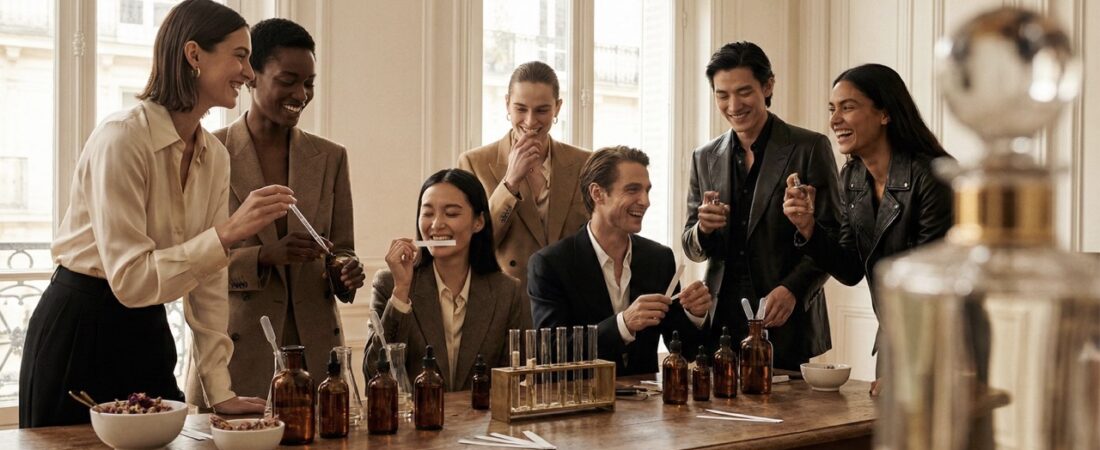
The leadership team engages in a Signature Scent Workshop guided by a Master Perfumer. They don’t just pick a pleasant smell; they undergo a “Brand Decryption” to identify their core values: Stability, Heritage, and Discretion. They translate these values into specific olfactory notes: Cedarwood for stability, Leather for heritage, and Iris for discretion.
The atmosphere transforms. They diffuse this bespoke scent in their reception areas and meeting rooms. Six months later, a long-term client remarks, “I don’t know what it is, but I feel calmer the moment the elevator doors open.” The scent has become a subconscious signal of safety. The brand is no longer just a logo; it is an atmosphere.
The Protocol: Designing Your Olfactory Logo
You do not need to spray perfume in the boardroom. You need a subtle, intentional olfactory architecture.
1. Audit the “Base Note”: Walk into your client-facing spaces. What is the default smell? Coffee? Dust? Stress? Neutralize the negative before you add the positive.
2. Align Scent with Strategy: If your brand strategy is “Innovation and Agility,” do not use heavy scents like Vanilla or Musk (which signal comfort and slowness). Use Citrus, Vetiver, or Mint—notes that signal alertness and clarity.
3. The “Take-Home” Anchor: Extend the memory beyond the meeting. If you host a Fragrance Co-Creation session as a client event, the small bottle they take home becomes a permanent physical link to your relationship. Every time they wear it, the neural pathway to your brand is reactivated.
Visuals tell your client what you do. Scent tells them how to feel about it.
Next Step
Reflect: What is the “scent track” of your current client experience? Is it intentional or accidental? Act: Create a permanent memory anchor for your brand with our Signature Brand Fragrance Experience. Explore client experience events and relationship-building workshops.