
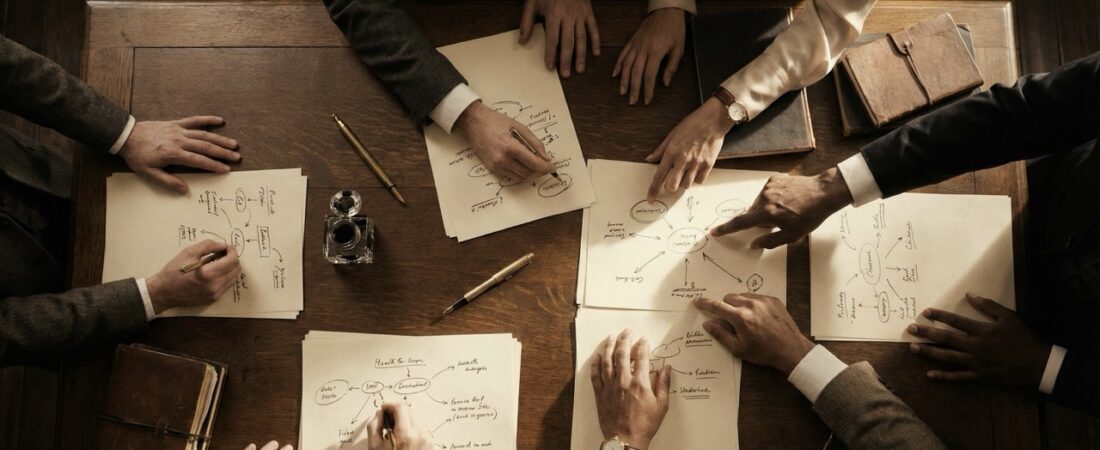
We spend vast resources acquiring diverse minds. We recruit for different backgrounds, cognitive styles, and observational depths. Then we place these carefully selected individuals into a room, present a complex problem, and ask them to shout out the answers. The deeply ingrained ritual of verbal brainstorming actively suppresses our best thinking. Why do we pay for intellect but structurally reward volume? It is a strange corporate habit. We build teams of experts, yet we force them to generate solutions through a singular, noisy funnel.
Why 75% of the Airtime Belongs to Three People
Verbal brainstorming is structurally flawed. It intrinsically favors extroversion and processing speed over depth and quality. When a group sits around an oak table to ideate verbally, a predictable friction emerges. We encounter “production blocking.” This is the cognitive load of holding onto your own idea while waiting for a colleague to finish talking. By the time there is a pause, the original thought is often lost, filtered, or deemed no longer relevant.
Then there is the quiet pull of “anchoring” and “conformity pressure.” The first few ideas pitched in a room set an invisible boundary. The group psychologically aligns with these early concepts, narrowing the scope of creativity before it even has a chance to breathe. But the math reflects a harsh reality. In traditional brainstorming, 60 to 75 percent of the talking is done by only a few people (Leigh Thompson, Kellogg School of Management). The loudest voices, rather than the sharpest insights, end up guiding the strategy.
The Science of Silence and a 42% Premium on Originality
The most forward-thinking teams are replacing the whiteboard shouting match with intentional silence. They use a method known as “Brainwriting.” This is the practice of asynchronous, written ideation prior to any verbal discussion. Treat it not as a passing trend, but as a dignified, proven protocol for the Organizational Brain.
The data reveals a stark contrast. Brainwriting groups produce 20 percent more ideas overall and, critically, 42 percent more original ideas compared to conventional verbal groups (Leigh Thompson, Kellogg School of Management). When individuals alternate between silent writing and group review, the rate of idea generation is 71 percent higher per person per minute (Paul Paulus, Association for Psychological Science).
This practice connects deeply to psychological safety models developed by Amy Edmondson. Writing removes the immediate fear of judgment. It strips the bias of hierarchy from the idea itself. The focus shifts entirely to the quality of the thought, rather than the rank or charisma of the person delivering it.
From Commander to Facilitator: The 10-Minute Ritual
For the executive, this requires a subtle shift in posture. The role moves from Commander to Facilitator. You become the host of the room’s collective intelligence.
The sequence is simple but requires discipline. First, define the tension clearly. Frame the exact problem that needs solving. Next, enforce ten minutes of absolute silence. Provide heavy-stock paper cards and good pens. Allow the room to sit in quiet reflection. People write their thoughts individually without the friction of interruption. Only after this silent period does the floor open for collective review. The physical act of writing on paper brings a sense of craft and groundedness to the work. It respects the natural cognitive process.
Dignity, Retention, and the Best Minds
Better margins and superior products are not born from dominant personalities. When we level the playing field through brainwriting, we prove to our teams that we value their actual intellect over their ability to command a room. It is a small structural adjustment that pays massive cultural dividends. We create an environment where the deepest thinkers are given the space to resonate. And that is exactly how you build a resilient, highly capable organisation.
References & Further Reading
- Edmondson, A. (1999). Psychological Safety and Learning Behavior in Work Teams. Administrative Science Quarterly.
- Paulus, P. B., & Brown, V. R. (2007). Toward more creative and innovative group idea generation: A cognitive-social-motivational perspective of brainstorming. Social and Personality Psychology Compass.
- Thompson, L. (2003). Improving the creativity of organizational work groups. Academy of Management Executive.