
In the legacy model of management, the executive is an administrator. Their role is defined by oversight, resource allocation, and the removal of obstacles. It is a mechanical function, born of the industrial age: keep the machine running.
But in the knowledge economy, the machine is no longer mechanical; it is biological. It is human. And humans do not respond well to administration. They respond to resonance.
The most effective leaders today have quietly shifted their operating model. They are stopping to “manage” their culture and starting to “curate” it. They are adopting the mindset of an Art Director.
An Art Director does not paint every pixel. Instead, they ruthlessly control the inputs: the tone, the environment, the standards, and the emotional arc of the experience. They understand that if the environment is incoherent, the output will be mediocre.
The Biology of “Vibe”
Why is curation a strategic necessity? Because the human brain is a pattern-matching machine that deletes 99% of the information it receives.
If you attempt to build culture through “Corporate Comms”—mass emails, value statements on the wall, mandatory training modules—the brain filters this out as background noise. It is low-signal input.
To penetrate the filter, information must be experiential. It must be felt.
The data on this is unambiguous. When an organization shifts from “telling” (passive learning) to “experiencing” (gamified or interactive learning), the impact on the brain changes. Research from the University of Colorado Denver quantifies the massive gap between administration and curation.
Vitality Insight Gamified and experiential learning methods result in 90% better retention of knowledge compared to traditional training methods.
Source: Encyclopedia of Vitality (University of Colorado Denver)
If you are merely “managing” information flow, your team retains 10% of it. If you “curate” an experience, they retain 90%.
The Human Moment
We recently audited the quarterly “All Hands” for a global fintech firm. The content was high-value—vital strategic pivots—but the format was administrative. The CEO stood on a stage, blinded by lights, reading bullet points to a darkened room of 500 people. The energy was dead. The “vibe” was compliance.
We advised the CEO to put on his Art Director hat. “If this meeting were a gallery opening,” we asked, “how would you design the entrance?”
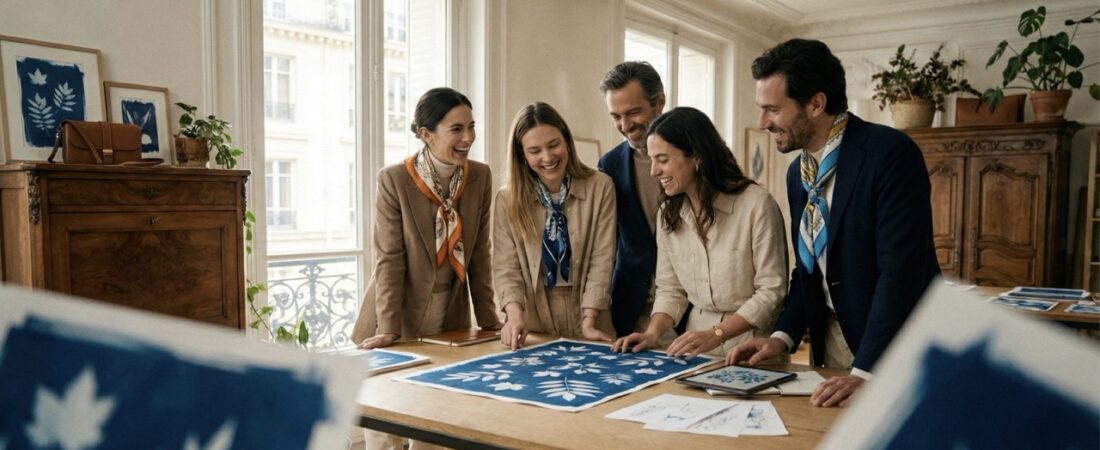
For the next quarter, they changed the format. No stage. No slides. They curated a “Gallery Walk.” The strategy was printed on large-format posters around the room. The leadership team stood by the posters with drinks, not microphones. The staff walked the room, discussing the strategy face-to-face with the executives.
The content was identical. But the experience shifted from passive to active. The “buzz” in the room was palpable. By curating the space rather than managing the time, the CEO turned a broadcast into a dialogue.
The Protocol: Three Acts of Curation
How does an executive apply the Art Director’s eye to daily operations?
1. Curate the Inputs (The Edit) An Art Director is defined by what they remove. Most corporate cultures are cluttered with noise—too many channels, too many conflicting priorities.
- The Move: Ruthlessly edit the sensory inputs of your team. If a meeting has no clear purpose, cut it. If a Slack channel creates anxiety, archive it. Protect the “white space” where deep work happens.
2. Curate the Environment (The Set) Your physical and digital environment is the “set design” of your culture.
- The Move: Does your boardroom signal “interrogation” (bright lights, hard surfaces) or “collaboration” (softer acoustics, natural light)? Small sensory shifts—like the Sonic Branding of a space—change the biological state of the people entering it.
3. Curate the Rituals (The Script) Management relies on routines (what we have to do). Curation relies on rituals (what we choose to do to create meaning).
- The Move: Replace the “Status Update” with the “Show and Tell.” Celebrate the craft of the work, not just the completion. Elevate the mundane into the meaningful.
You are not just running a P&L. You are the Chief Experience Officer for your talent. Curate accordingly.
Next Step
Reflect: Look at your next team gathering. Is it designed for compliance (management) or resonance (curation)? Act: Learn how to design high-retention experiences with our Gamified Team Challenges. https://culturevitale.com/companies/