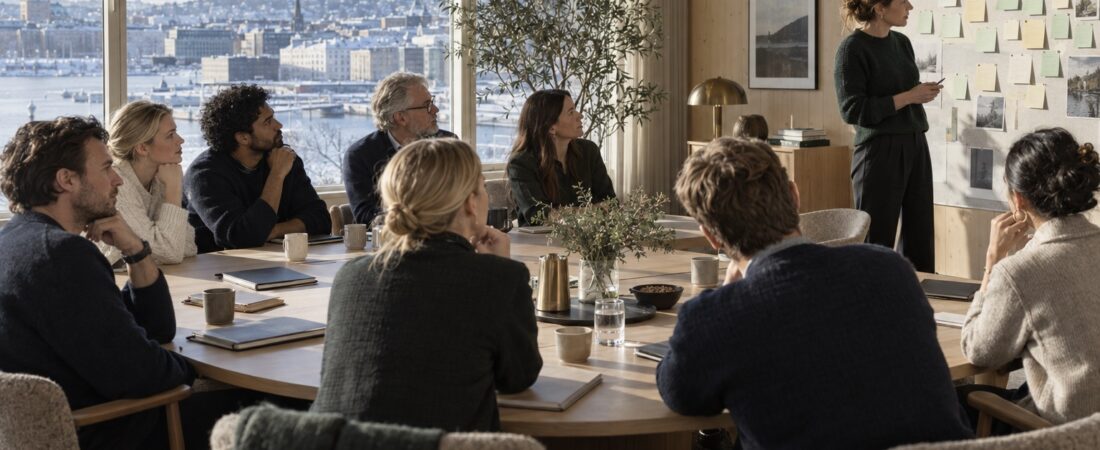
Planning a company kick-off in Norway works when it does three things: gives the team a shared direction, creates space for real conversation, and generates energy people carry back to their desks. Those three jobs determine your structure, your facilitation approach and your choice of experience. Purpose first; programme second.
Kick-off components at a glance
From Oslo waterfront venues to retreat spaces across the country, the building blocks of a well-run kick-off remain consistent. Below are the core components for corporate kick-off days across Norway, each mapped to its purpose, format and timing.
| Component | Purpose | Format | Timing in the day | Who leads |
|---|---|---|---|---|
| Opening experience | Settle the room, raise energy and signal that this day is different | Improvisation, storytelling or a short creative warm-up | 09:00-10:00 | External facilitator |
| Direction-setting address | Share the period’s priorities and provide context only leadership can give | Keynote or address with open Q&A | 10:00-11:30 | Senior leadership |
| Facilitated working sessions | Turn strategy into team-level action; surface real concerns in a safe setting | Guided small-group breakouts with structured prompts | 11:30-13:00 and 14:00-15:30 | Facilitator with team leads |
| Shared experience | Build connection, shift the day’s register and embed shared memory | Culinary masterclass, craft session or outdoor walk | 15:30-16:30 | Expert host |
| Commitments close | Anchor the day in specific, owned next steps | Plenary: each team states one commitment aloud | 16:30-17:00 | Facilitator and leadership together |
| Hosted dinner | Consolidate relationships in an informal register | Shared table with a ritual opener: a toast, a word from each person or a reflection prompt | Evening from 19:00 | Host or self-led |
Start with purpose, not programme
The most common reason a kick-off leaves people flat is that it was designed from the schedule outward rather than from intent inward. Before any agenda goes on paper, three questions are worth settling: what do people need to understand, what do they need to say to each other, and how should they feel as they leave? Those questions shape the structure. Leadership sets the direction; facilitation converts it into shared meaning at team level. Locking a venue before the purpose is clear produces a calendar date, not a kick-off.
The arc of a well-designed day
A single full day carries the cognitive weight of the morning, a genuine reset over lunch, structured working sessions in the afternoon and a hands-on shared experience that shifts energy and builds connection. The close matters: a brief plenary in which each team names one specific commitment turns the day from an event into a mandate. An evening dinner, when it follows, consolidates what the day started. For teams with a commercial focus alongside the cultural alignment, sales team kick-off design follows the same arc with the working sessions tuned to pipeline and motivation. Oslo-based teams can draw on venues from Aker Brygge to Bjørvika and run the full format without an overnight stay.
Example agenda: one-day kick-off for 60 people
| Time | Segment | Format | Notes |
|---|---|---|---|
| 09:00 | Arrival and welcome | Coffee, light breakfast, table cards with an opening question | Conversation starts before the day officially opens |
| 09:30 | Opening experience | Improvisation or storytelling with a facilitator | Signals a different kind of day; loosens communication across levels |
| 10:30 | Leadership address | Direction and priorities; open Q&A | Honest and forward-looking; leaves genuine space for questions |
| 11:15 | Facilitated working sessions, round 1 | Groups of 8-10 with structured prompts; facilitator circulates | Strategy becomes team-level; real concerns surface here |
| 12:30 | Lunch | Shared table, informal | Intentional seating mix; no assigned team clusters |
| 13:30 | Facilitated working sessions, round 2 | Breakout groups; outputs shared in plenary | Builds on the morning; moves toward concrete actions |
| 15:00 | Shared experience | Hands-on craft, culinary session or a guided walk | Shifts energy; conversation continues in a different register |
| 16:15 | Breathwork or outdoor reset | Short breathwork or a ten-minute walk together | Clears the afternoon; readies people for the close |
| 16:45 | Commitments close | Each team states one commitment; noted and shared afterwards | Anchors the day in action, not aspiration |
| 17:00 | Day closes | ||
| 19:00 | Dinner | Shared table; ritual opener: a toast or a word from each team | Consolidates relationships; no working agenda required |
Where a shared experience belongs
The afternoon slot, after facilitated sessions have done their work, is where an experiential element earns most. By that point the team has been in strategy mode for several hours; a hands-on cooking masterclass, a ceramics session, a chocolate ritual or a walk in the friluftsliv (outdoor life) tradition shifts the register entirely. Conversation continues, but in a different part of the brain. Google’s research on team effectiveness found that psychological safety, the confidence to speak up in front of colleagues, mattered most to how teams performed, and a relaxed shared experience is one of the easiest ways to build that openness. In Oslo, Grünerløkka studios, the Nordmarka forest edge and Frogner park all sit within easy reach of central venues.
What makes a kick-off land: the essentials
- A clear brief written before the venue search begins.
- A morning that gives leadership enough time to speak honestly and the team enough time to ask real questions.
- Facilitated small-group sessions alongside the plenary: people need time to speak as well as listen.
- A deliberate shift in format in the afternoon: a hands-on experience moves energy in ways a working session cannot.
- A commitments close that names specific actions and owners before the room empties.
- Intentional seating at meals that mixes teams and levels.
- Everything prepared and cleared away by an experienced host so the team simply arrives and takes part.
What should a company kick-off include?
A well-structured company kick-off in Norway includes five elements: a direction-setting address from leadership, facilitated small-group sessions that turn strategy into team-level action, a shared lunch that functions as a genuine social reset, a hands-on shared experience in the afternoon and a commitments close that names specific next steps and owners. Adding a local outdoor element in the friluftsliv tradition fits naturally into the afternoon, whatever the season.
How long should a kick-off be?
A single full day, 09:00 to 17:00, is the right container for most teams: long enough to hold the cognitive work of the morning and the experiential work of the afternoon without losing energy or focus. Adding an evening dinner extends the social value for a modest additional commitment. Two-day formats work well for larger organisations or when the strategic agenda is genuinely complex; a half-day is sufficient for a focused planleggingsdag (planning day) or fagdag (professional development day) with a tighter scope.
What is the difference between a kick-off and a planleggingsdag?
A kick-off is typically a whole-company or whole-team event that marks a new period, aligns direction and generates collective energy. A planleggingsdag is usually more operational: teams use it to review workstreams, set goals and coordinate for the period ahead, often in a tighter format. A fagdag is focused on learning and skill-building rather than strategic alignment. The formats can overlap; many organisations run a combined kick-off and planleggingsdag in January and a lighter fagdag mid-year.
When should we plan a January kick-off?
The January window follows the Christmas break with a clean reset and gives teams a shared horizon for the year. Venues and experienced facilitators for this period fill early; locking the date in autumn, before fellesferie (the shared summer holiday, typically in July), is the most reliable approach. The August and September window after fellesferie serves the same function for teams whose year naturally resets after the summer.
Can an external facilitator lead part of the day?
Bringing in an experienced facilitator for the opening session, the working sessions or both is one of the most effective investments a kick-off can make. An external facilitator holds a neutral position in the room: they can surface real concerns, redirect conversation and keep groups on track in ways an internal leader cannot easily do while also carrying the day’s content. Leadership offsite facilitation and internal kick-off design sit well together, with facilitation taking the opening and the working sessions and leadership taking the direction-setting address.
Plan your kick-off
Tell us your goal, group size and timing and we will curate the facilitation, the arc of the day and the shared experience, or explore our Norway kick-off and planning-day options and bring together the elements that suit your team.
References
- Google re:Work, understanding team effectiveness: rework.withgoogle.com
- Gallup, State of the Global Workplace: gallup.com